
Phyllostachys aureosulcata ‘Aureocaulis’ – Golden Beijing Bamboo;
Sun to bright shade, to 26 feet, USDA Zones 6b-9, a yellow-caned form of P. aureosulcata.
Sun to bright shade, to 26 feet, USDA Zones 6b-9, a yellow-caned form of P. aureosulcata.
| Click on any photo for larger view Use back button to return |

| 'OUR' BAMBOO NURSERY 30 Myers Road Summertown, Tn. 38483-7323 U.S.A Phone: (931) 964-4151 Fax: (931) 964-4228 Hours: 7:00 am-5:00 pm CST Visits By Appointment Only |


Phyllostachys aureosulcata ‘Harbin’ – Harbin Ribbed Bamboo;
Sun/bright shade, to 26 feet, USDA Zones 6b-9. Culms have a celery-like green ribbing with yellow valleys.
This is a stable, virally induced mutation – it is not infectious!
Sun/bright shade, to 26 feet, USDA Zones 6b-9. Culms have a celery-like green ribbing with yellow valleys.
This is a stable, virally induced mutation – it is not infectious!

Phyllostachys aureosulcata ‘Spectabilis’
To 25 +/- feet. A reverse of the species type with yellow canes with a dramatic green sulcus. Does well
in Kansas City!
To 25 +/- feet. A reverse of the species type with yellow canes with a dramatic green sulcus. Does well
in Kansas City!

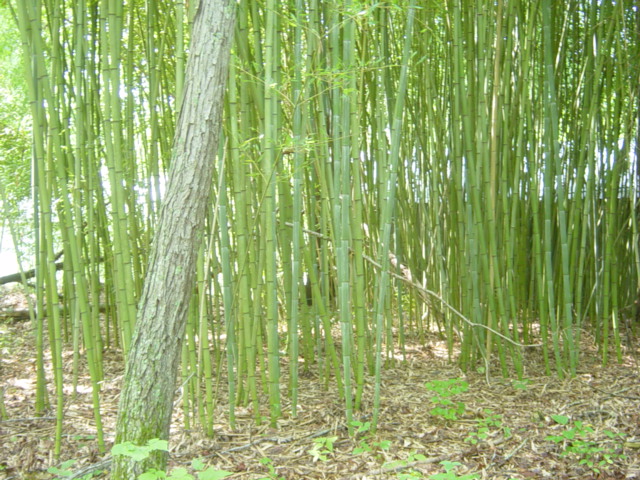

Edge of an established grove
Grove interior
Shown are 12-15' landscape grade
clumps in our holding yard
clumps in our holding yard
Phyllostachys bissetii – Bisset’s Bamboo;
Our most popular for visual screening, formal (can be sheared as we saw in Belgium and as one of our clients near
Kansas City does on the island separating a boulevard.) or informal, to 40 feet – usually less, USDA Zones 6-9.
One of the toughest, establishes rapidly. Dark green leaves and canes, early shooting with tasty shoots.
Our most popular for visual screening, formal (can be sheared as we saw in Belgium and as one of our clients near
Kansas City does on the island separating a boulevard.) or informal, to 40 feet – usually less, USDA Zones 6-9.
One of the toughest, establishes rapidly. Dark green leaves and canes, early shooting with tasty shoots.


Phyllostachys bissetii shown as
a ¼ mile long sheared hedge at
an office park near Kansas City.
a ¼ mile long sheared hedge at
an office park near Kansas City.


Phyllostachys dulcis – Sweet Shoot Bamboo;
To 40 feet, USDA Zones 7-9. Reaches 3 1/2 inch diameter here but has thin walls so not good for
construction – mostly grown for food and/or shade. Sizes up quickly.
To 40 feet, USDA Zones 7-9. Reaches 3 1/2 inch diameter here but has thin walls so not good for
construction – mostly grown for food and/or shade. Sizes up quickly.


Inside well groomed grove showing
cane bases
cane bases
80± year-old grove in Anderson S.C.
controlled on this side by mowing and
by a creek on back side.The Southeast
Chapter of ABS holds a workday each
spring to remove weeds and dead or
dying canes and keep the grove looking
its best!
controlled on this side by mowing and
by a creek on back side.The Southeast
Chapter of ABS holds a workday each
spring to remove weeds and dead or
dying canes and keep the grove looking
its best!
Lining a drive in the South
of France (150 year old
seedling Redwoods in
background)
of France (150 year old
seedling Redwoods in
background)
Phyllostachys edulis – Moso Bamboo;
The most widely grown and utilized bamboo worldwide traditionally, to 75 feet, USDA Zones 7-9. 5.9 inches d.b.
h. (diameter at breast height) – is the largest we’ve seen in the U.S. Moso is very early shooting and is grown for
both food and timber
The most widely grown and utilized bamboo worldwide traditionally, to 75 feet, USDA Zones 7-9. 5.9 inches d.b.
h. (diameter at breast height) – is the largest we’ve seen in the U.S. Moso is very early shooting and is grown for
both food and timber
Page 2